



Hi, I’m Nebi. In today’s competitive market, product managers constantly face the challenge of evolving products to meet ever-changing customer expectations. One of the most effective ways to achieve this is through real-time customer feedback, particularly through video insights. These rich data sources not only provide detailed information but also offer an emotional connection that written feedback lacks. This article explores how product managers can use video feedback to enhance product development, drive innovation, and improve user experience.

What is Video-Based Customer Feedback?
Video-based customer feedback allows customers to express their thoughts, experiences, and concerns through video submissions rather than traditional text reviews or surveys. These videos provide visual and auditory cues, such as tone of voice and facial expressions, which help product managers better understand the customer’s emotional state and level of satisfaction. In contrast to written feedback, video feedback is often more detailed and vivid, making it easier to spot the exact pain points or features that excite users.
Example: A major electronics company once relied on traditional surveys to gather customer feedback on a newly launched device. After switching to video feedback, they discovered that many users were struggling with a small but critical feature, which was not clearly expressed in written comments. The visual demonstration of the issue enabled the company to quickly iterate on the design, improving customer satisfaction by 25%.
Advantages of Video Feedback
Rich Data
Video feedback provides product managers with comprehensive data, including both visual and auditory elements. This multidimensional feedback offers a fuller understanding of the customer’s experience compared to written surveys, which are often limited by space and context.
Empathy and Understanding
Product managers can better empathize with customers by observing their facial expressions, tone of voice, and body language. A customer’s frustration or excitement can be immediately perceived, allowing teams to respond more effectively and tailor their product roadmaps accordingly.
Clarity and Detail
Unlike text feedback, where important details may be lost in translation, video allows users to clearly articulate their thoughts. They can walk through the problem step by step, providing real-time demonstrations of issues or pointing out specific features they love.
Technical Requirements and Tools
To fully leverage video feedback, companies need the right technology. There are several tools available to assist product managers in collecting, analyzing, and integrating this feedback into their workflows.
Necessary Technologies
Product managers need a platform that supports seamless video submission and storage, ensuring that feedback can be easily accessed and reviewed. Tools like RecRam allow users to submit feedback in real-time without the hassle of installing third-party apps.
Video Analysis Software
Analyzing video data manually can be time-consuming. Fortunately, AI-powered software such as Clarifai and Vidyard can automatically analyze video submissions, flagging key moments and emotions. AI sentiment analysis helps detect customer satisfaction levels based on vocal intonation and facial expressions.
Integration with Product Management Tools
Video feedback platforms should integrate with popular project management tools like JIRA or Trello, ensuring that the collected insights are immediately actionable within the product development lifecycle.
Methods for Collecting Video Feedback
There are several ways to gather video feedback throughout the product lifecycle:
User Testing and Beta Programs
During the beta phase of a product launch, companies can ask testers to record their experiences. This method allows product managers to see how users interact with the product and identify any usability issues before the product reaches the broader market.
Customer Support Interactions
Customer support teams can also gather valuable feedback during calls or chats. By capturing these interactions on video, product teams gain insight into recurring issues and can develop targeted improvements.
Voluntary Submissions
Encouraging customers to voluntarily submit video feedback can provide an honest and spontaneous reflection of their product experience. Offering incentives, such as discounts or entry into a prize draw, often motivates more customers to participate.
Analysis and Insight Extraction
Once collected, video feedback must be analyzed to extract actionable insights. This can be done both manually and automatically.
Manual vs. Automated Analysis
Manual analysis requires teams to watch and categorize feedback videos. While this method allows for in-depth understanding, it is time-consuming. On the other hand, automated analysis powered by AI can quickly assess large volumes of feedback, identifying trends and prioritizing issues based on customer sentiment.
Sentiment Analysis
AI-driven sentiment analysis tools evaluate a customer’s tone, body language, and facial expressions, giving product managers a clear understanding of how the product makes users feel
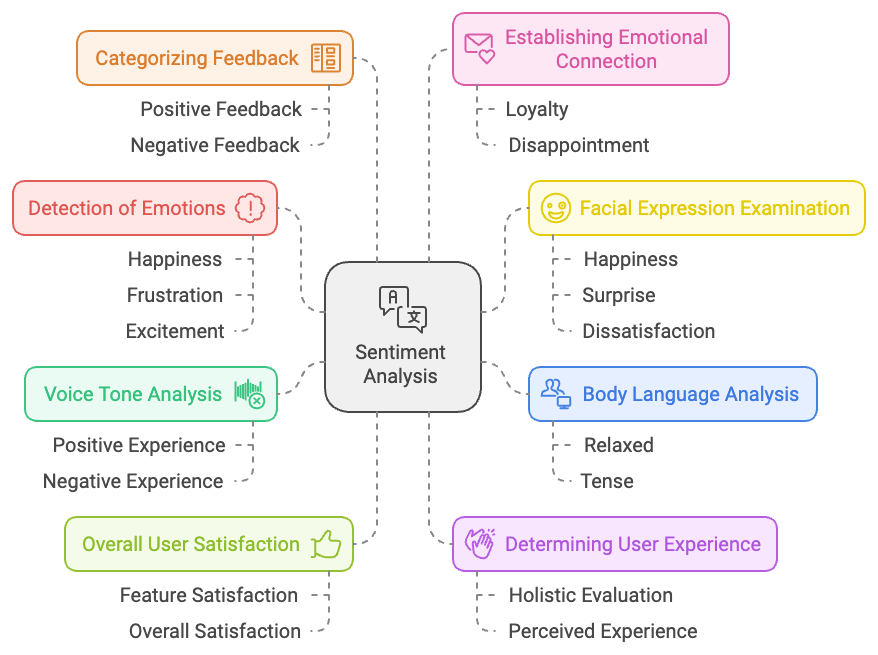
- Detection of Emotions:
- Identifying the emotions users experience while using the product (happiness, frustration, excitement, etc.).
- Body Language Analysis:
- Examining the body language movements users exhibit while using the product, such as whether they feel relaxed or tense.
- Facial Expression Examination:
- Analyzing users’ facial expressions in detail to identify emotions such as happiness, surprise, or dissatisfaction.
- Voice Tone Analysis:
- Assessing the tone of voice users use while interacting with the product or giving feedback, and determining whether it indicates a positive or negative experience.
- Overall User Satisfaction:
- Measuring users’ overall satisfaction levels with the product and identifying which features of the product are associated with this satisfaction.
- Determining User Experience:
- Holistically evaluating the experience provided by the product to the user and understanding how this experience is perceived by the user.
- Categorizing Feedback:
- Categorizing users’ positive and negative feedback about the product to identify areas needing improvement.
- Establishing Emotional Connection:
- Evaluating the emotional connection users have with the product, analyzing emotional responses such as loyalty or disappointment towards the product.
Visual and Auditory Data Parsing
In addition to sentiment analysis, video feedback can be parsed for specific words or phrases, and visual cues can help identify common usability issues, like confusion over specific features.

Turning Insights into Action
The ultimate goal of gathering video feedback is to inform the product development cycle. These insights must be put to use through iterative testing and refinement.
Feedback Loop
A successful feedback loop involves gathering video insights, making the necessary adjustments to the product, and testing these updates with the same or new users. This iterative process ensures continuous improvement and alignment with customer expectations.
Prototyping and A/B Testing
Using video feedback to inform A/B testing helps product managers compare variations of features to see which one resonates more with users. Insights drawn from these tests can then lead to further refinements.
In 2024, video consumption is becoming increasingly important in the field of marketing. Research conducted by HubSpot and Wistia shows that video plays have increased by 13% for small and medium-sized businesses and by 5% for large businesses. Consumers are increasingly relying on video content to learn about brands, with a particular preference for short videos. Videos are important for showing consumers how products work and identifying potential flaws. It is also emphasized that creating authentic and relatable content is crucial for increasing engagement in video marketing. Source : Hubspot
Iterative Development
Incorporating video feedback into each stage of the product development process allows for real-time adjustments, ensuring that the final product is in tune with user needs.
Success Stories and Case Studies
Companies that have embraced video feedback have seen measurable improvements in their product offerings.
Successful Companies

For instance, Slack used video feedback to understand how teams interact with its collaboration tool. The insights led to the development of several key features, including better notification controls and integrations, resulting in a 15% increase in user retention within a year.
Measurable Results
In another example, a global fashion retailer used video insights to improve the online shopping experience. Customer frustration with the site’s navigation system, as expressed in video feedback, led to an overhaul of the UX, which in turn boosted online sales by 18%.
Challenges and Solutions
While video feedback offers many advantages, it also comes with challenges.
Legal and Privacy Concerns
Collecting video data requires adherence to strict privacy regulations. Companies need to ensure they have proper consent from users before storing and analyzing their submissions.
Practical Barriers
Gathering and analyzing video feedback requires resources, both in terms of technology and workforce. Investing in AI-driven tools can mitigate some of these challenges by automating the most labor-intensive tasks.
Future Trends in Video Feedback
As video feedback gains popularity, we can expect new technologies to further enhance its potential.

- Advanced AI Sentiment Analysis:
- More sophisticated AI-driven sentiment analysis tools will be able to detect subtle emotional nuances, providing deeper insights into user feedback.
- Real-Time Feedback Processing:
- Real-time processing of video feedback will become common, enabling immediate identification and resolution of user issues, drastically improving response times.
- Augmented Reality (AR) Integration:
- AR technology will be integrated into video feedback platforms, allowing users to provide more interactive and detailed demonstrations of their experiences with products.
- Enhanced Data Privacy and Security:
- With growing emphasis on user privacy, video feedback systems will implement stronger data encryption and comply with the latest data protection regulations to ensure user data is secure.
- Multi-Language and Cultural Sentiment Analysis:
- Advanced multi-language sentiment analysis tools will become available, allowing for accurate interpretation of feedback from a diverse, global audience, taking cultural differences into account.
- Voice and Speech Emotion Recognition:
- Improved voice analysis technology will enable the detection of emotions through speech tone and patterns, providing additional context to feedback.
- Integration with Omnichannel Feedback Systems:
- Video feedback tools will be seamlessly integrated with other feedback channels (e.g., text, surveys, social media) to provide a unified view of customer sentiment across all platforms.
- Personalized Feedback Responses:
- AI will enable the creation of personalized responses to video feedback, enhancing user engagement and showing customers that their opinions are valued individually.
- Predictive Analytics for Customer Behavior:
- Using video feedback data, predictive analytics will forecast customer behavior trends, helping businesses proactively address potential issues and capitalize on positive trends.
- AI-Generated Insights Summaries:
- AI will automatically generate concise summaries of key insights from video feedback, allowing teams to quickly understand user sentiments and prioritize actions effectively.
AI and Machine Learning
AI-driven tools will continue to evolve, offering even more sophisticated methods for analyzing visual and auditory data. Machine learning models will become better at predicting customer needs, allowing companies to make proactive product adjustments.
Industry Shifts
In the near future, video feedback will become a standard practice for all product managers. The shift will likely drive higher levels of customer engagement, better product-market fit, and increased competitive advantage.
Conclusion
Video feedback represents a powerful tool for product managers looking to elevate their product development process. By offering rich, actionable insights, video feedback allows for deeper empathy, better user understanding, and more informed product decisions. Incorporating this feedback method into the development cycle will not only improve customer satisfaction but also lead to more innovative products.
Ready to try it?
Stop reading. Start listening.
Recram turns feedback into video conversations your team actually watches.
Start Free — No Credit Card
Written by
Nebi Kara
Part of the Recram team — building the future of video‑first feedback.