

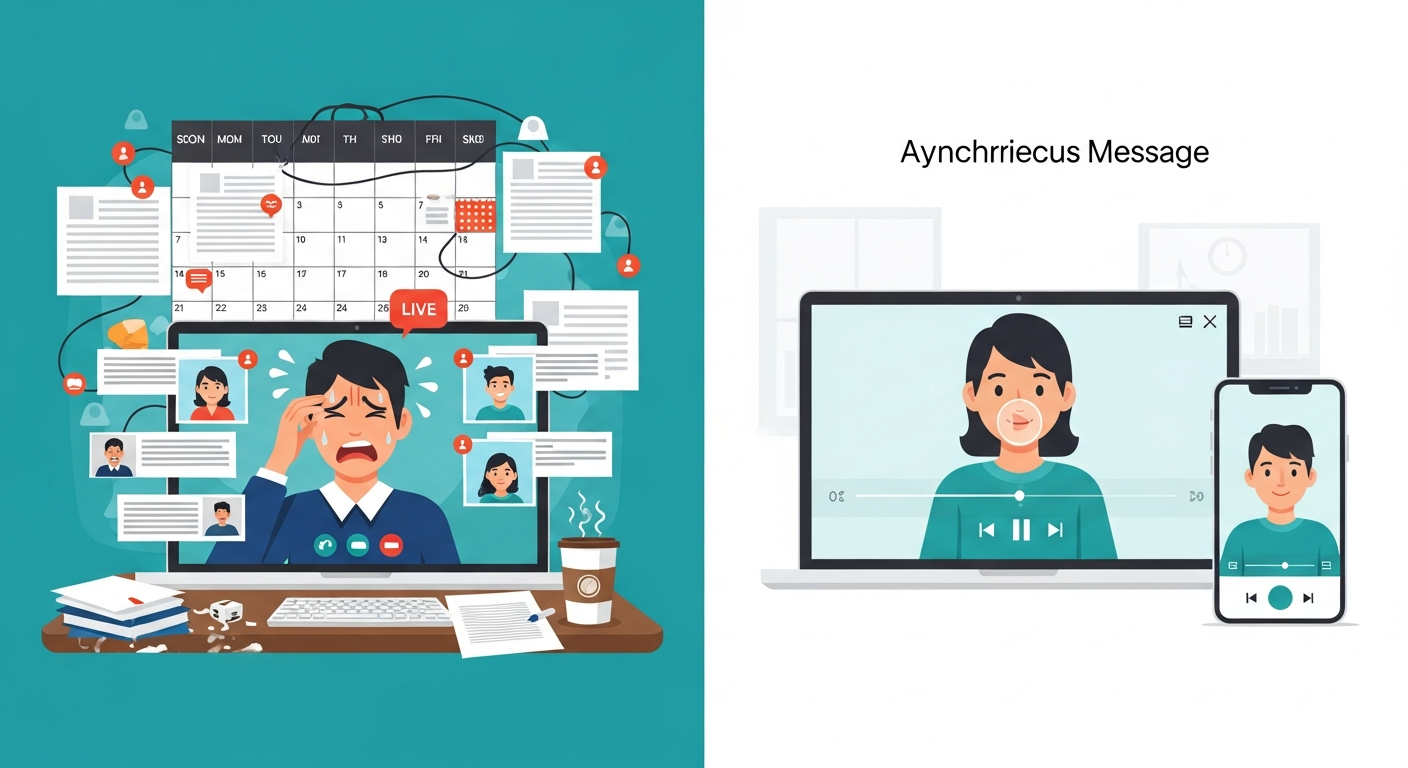


The hiring bottleneck in 2026 is no longer finding candidates — it’s screening them fast enough. A typical corporate job posting receives 250 applicants. Phone-screening even 20% of those means 50 calls, each lasting 20-30 minutes. That’s 17-25 hours of recruiter time per role, before a single hiring manager sees a candidate.
Companies still relying on live phone screens for initial screening are losing top candidates to faster-moving competitors. According to LinkedIn’s 2026 Talent Trends report, 60% of candidates accept the first offer they receive, not the best one. Speed is a competitive advantage, and async video interviewing is the most effective tool available to increase screening throughput without sacrificing quality.
But async video interviews aren’t right for every stage, every role, or every company. This guide breaks down exactly when to use each format, backed by data from 500+ hiring teams.
What Is an Async (One-Way) Video Interview?
An asynchronous video interview — also called a one-way video interview — is a screening format where candidates record their answers to pre-set questions on their own schedule. There is no live interviewer, no real-time interaction, and no scheduling coordination required.
How it works:
- The recruiter creates a question set (typically 3-5 questions) with time limits per question (usually 60-90 seconds)
- The candidate receives a shareable link — no account creation or app download needed in modern tools
- The candidate records answers at a time that works for them — evenings, weekends, between their current job’s meetings
- The recruiter reviews responses asynchronously, using a structured rubric or AI-assisted scoring
- Top candidates advance to live interview stages
Async video interviews are primarily used at the initial screening stage — replacing the traditional phone screen. They’re not designed for final rounds, executive assessment, or roles where real-time problem-solving is the core competency.
What Is a Live Video Interview?
A live video interview is what most people picture when they think “video interview”: two or more people connected in real time via video call — Zoom, Teams, Google Meet, or a dedicated platform. It has all the dynamics of an in-person interview, including conversation flow, follow-up questions, and live rapport-building.
Live video interviews are typically used for:
- Technical assessments: Live coding sessions, architecture reviews, problem-solving under observation
- Panel interviews: Multiple interviewers assessing culture fit and team dynamics simultaneously
- Final rounds: Offer conversations, executive sign-offs, and closing discussions where relationship-building matters
- Senior and executive roles: Where depth of assessment requires real-time probing and contextual follow-up
Async vs Live: Head-to-Head Comparison
| Factor | Async Video Interview | Live Video Interview |
|---|---|---|
| Scheduling time | Zero — candidate self-serves | 2-5 days average |
| Candidates screened per week | Unlimited | 8-12 per recruiter |
| Interviewer time per candidate | 4-6 minutes (review) | 30-45 minutes |
| Candidate flexibility | High — record anytime, anywhere | Low — fixed time slot |
| Depth of assessment | Medium — structured, no follow-up | High — dynamic, probe ability |
| Best for | Stage 1 screening (replaces phone screen) | Final rounds, technical depth, senior roles |
| Bias risk | Lower — structured questions, rubric scoring | Higher — halo effect, interviewer fatigue |
| Candidate experience | Flexible, low-pressure | More engaging, two-way |
| Cost per screen | Low | High |
When Async Video Interviews Win
Async video interviewing outperforms live screening in specific, well-defined conditions. Understanding these conditions is the key to deploying it effectively.
High Application Volume (50+ Per Role)
When you’re managing 100, 200, or 500 applicants for a role, live phone screens are simply not viable. The math doesn’t work. Async video lets you screen all applicants consistently — using the same questions, the same time limits, evaluated against the same rubric — and surface the top 20% for live rounds. Companies using this approach typically cut time-to-hire by 40-60% while maintaining quality of hire.
Remote-First Teams Across Time Zones
Scheduling a live interview between a recruiter in New York and a candidate in Singapore means someone is interviewing at midnight. Async eliminates the timezone coordination problem entirely. The candidate records at 10am their time; the recruiter reviews at 10am their time. Neither sacrifices quality of engagement for geography.
Standardized Roles at Scale
Customer success, sales development, customer support, and similar roles have well-defined competencies that can be assessed through structured behavioral questions. When the job’s success predictors are known and the questions can be standardized, async video is highly effective at scale — because the same rubric applies consistently across hundreds of responses.
Speed as a Competitive Advantage
In competitive talent markets, top candidates accept offers within days of starting their search. Companies that can move from application to qualified shortlist within 48-72 hours consistently win offers over slower competitors who take weeks. Async video eliminates the scheduling friction that causes most of that delay.
When Live Interviews Are Still Essential
The rise of async doesn’t mean live video interviews are obsolete. They remain the superior format for specific stages and role types:
Senior and Executive Roles
For VP, Director, and C-suite roles, the relationship element of the interview is itself a signal. How a candidate handles a conversation with the CEO, how they respond to challenging follow-ups, how they carry themselves when the stakes are visible — these are assessments that async video cannot replicate. Senior hiring is relationship-intensive, and rightly so.
Roles Requiring Real-Time Problem Solving
Software engineering roles with live coding assessments, sales roles with live roleplay simulations, creative roles with live brief responses — these competencies can only be observed in real time. The artifact of watching someone think through a problem is fundamentally different from hearing them describe how they’d think through it.
Culture Nuance Assessment
Behavioral questions in async format can reveal work style and values, but certain cultural fit dimensions require live interaction — particularly how a candidate engages in discussion, responds to disagreement, and builds rapport with people they’ve just met. These are final-round assessments, not first screens.
Offer and Closing Conversations
No candidate should receive an offer from a company they’ve only interacted with asynchronously. The final stage of any hire — the offer conversation, the negotiation, the “are you excited about this?” moment — belongs in a live, human interaction. This is where commitment is built, and it cannot be outsourced to video recordings.
The Hybrid Model: How Top Hiring Teams Use Both

The most effective hiring teams don’t choose between async and live — they use both strategically at different stages of a structured funnel.
Here’s the hybrid model used by high-performing talent acquisition teams:
- Stage 1: Async Video Screen (replaces phone screen)
3-5 questions, 90 seconds each. All applicants invited. AI scoring surfaces the top 20-30%.
Time investment: 4-6 minutes per candidate reviewed - Stage 2: Live Technical or Skills Assessment
45-60 minute live session focused on role-specific competency. Structured format, multiple evaluators.
Time investment: 45-60 minutes per candidate - Stage 3: Live Panel Interview
Culture, team fit, and cross-functional perspective. Typically 60-90 minutes with 3-4 interviewers.
Time investment: 60-90 minutes per candidate - Stage 4 (Optional): Async Reference Videos
Request video references from 2-3 past managers — structured questions about performance, work style, and impact. More revealing than a phone reference call because references have time to prepare thoughtful answers.
Time investment: 3-4 minutes per reference video reviewed
The result: Teams using this hybrid model consistently report screening 3x more candidates with the same recruiter headcount, while maintaining or improving hiring quality metrics. The key is using each format where it provides the most value — not as a wholesale replacement for live interaction.
Candidate Experience: What the Data Shows

A common concern about async video interviews is that candidates will find them impersonal or off-putting. The data tells a more nuanced story:
- 78% of candidates prefer async screening over surprise phone calls from recruiters they’ve never spoken to, according to LinkedIn’s 2026 Candidate Experience survey
- Candidates who record async video interviews report lower anxiety than those who undergo live phone screens — primarily because they can choose when to record, and because they can see the questions before the time limit starts
- Async video removes the time zone disadvantage for global candidates — a significant equity improvement over live screening
- However, 24% of candidates find async video “impersonal” when they receive no human follow-up communication after submitting — highlighting the importance of timely, personal response after review
How to Make Async Feel Human
The impersonality concern is real but addressable. Two practices make the biggest difference:
- Hiring manager intro video: Record a 60-second personal video from the hiring manager introducing themselves and explaining why the role is exciting. Include this at the start of the async interview. Candidates who receive this report 40% higher satisfaction with the process.
- Personalized follow-up: Even a one-line personal email within 48 hours of submission (“Thank you for recording — I’m reviewing your video today and will follow up by [DATE]”) dramatically improves candidate experience scores.
Bias in Video Interviews: Async vs Live
Both formats introduce bias risks, but the sources differ — and async video, when done well, has structurally lower bias exposure.
Live Interview Bias Risks
- Halo effect: A strong first impression colors assessment of all subsequent answers
- Interviewer fatigue: The 8th interview of the day receives less rigorous evaluation than the 2nd
- Affinity bias: Interviewers unconsciously favor candidates who remind them of themselves
- Order effects: Candidates interviewed after a weak candidate benefit; those interviewed after a strong candidate suffer
Async Video Bias Risks
- Appearance bias: Evaluators may still be influenced by how candidates look on video
- Accent bias: Non-native speakers may be scored lower on “communication clarity”
- Background/setup bias: Candidates with better recording setups may be unconsciously rated higher
Best Practices to Reduce Async Bias
- Read transcripts before watching video: RecRam generates automatic transcripts — evaluate the content first, then watch for delivery
- Calibrate your rubric: Before reviewing candidates, rate a set of sample responses together as a team to align on standards
- Use AI scoring as a first-pass filter: AI scoring based on content and structure is more consistent than human impression
- Blind the evaluator to candidate name/background where possible: Focus on the answer, not the person
How to Implement Async Video Screening in Your Hiring Process
Implementing async video interviewing is a 3-hour setup, not a multi-month project. Here’s the exact workflow using RecRam’s recruitment platform:
- Define your question set: 3-5 questions per role, using the behavioral frameworks discussed above. Each question gets a 60-90 second limit.
- Record a hiring manager intro video: 60 seconds, in your browser. No production needed — authenticity matters more than polish.
- Set your evaluation rubric: 4 criteria, 0-3 scale per criterion. Calibrate with one practice review session before using it live.
- Generate your shareable link: One link per role or per candidate batch. Candidates open in browser, no account required.
- Send invitations: Use the template in this guide, personalized with role title and deadline.
- Review AI-scored results: RecRam’s AI flags the top performers by default — focus your review time on the top 30% and spot-check the middle tier.
- Advance to live rounds: Use the async review to write specific, informed questions for the live interview — making the live session more efficient and more revealing.
Frequently Asked Questions
Is async video interviewing fair to candidates?
When implemented with structured questions, consistent rubrics, and equal access (no app download required, mobile-friendly recording), async video is objectively fairer than live screening — because it eliminates scheduling advantages for candidates in convenient time zones, reduces interviewer fatigue effects, and gives all candidates the same question set evaluated against the same criteria. The key fairness risk to manage is ensuring all candidates have equivalent technical access to recording (device + internet), which is a decreasing barrier in 2026.
How long should a one-way video interview be?
Total recording time of 7-12 minutes is the optimal range. At 5 questions with 90-second limits, that’s 7.5 minutes of candidate content — enough for a comprehensive initial screen without burning out candidates or generating hours of review footage. Keep each question under 2 minutes; completion rates drop significantly beyond that threshold.
Can I use async video interviews for senior roles?
As an initial screen to complement an application review, yes — but only for senior individual contributor roles, not leadership or executive positions. A VP-level candidate recording a 90-second video answer as their first interaction with your company sends the wrong signal about how you value their time. For executive roles, start with a brief phone call, then move to structured live video rounds.
What’s the difference between a video interview platform and Zoom?
Zoom is a live video communication tool — real-time, two-way. A dedicated video interview platform like RecRam supports the async workflow: structured question sets, per-question time limits, candidate consent and GDPR compliance, AI transcript generation, structured scoring rubrics, and team collaboration on review. Zoom can conduct a live interview; it cannot run an async screening workflow at scale.
Are async video interviews GDPR compliant?
With the right platform, yes. GDPR compliance for video interviews requires: explicit candidate consent before recording, clear disclosure of how the video will be used and stored, a defined data retention period, the candidate’s right to request deletion, and EU-region data storage for EU candidates. RecRam handles all of these at the platform level — consent capture is built into the candidate flow, and data processing agreements are available for enterprise customers. Always include your data processing disclosure in the candidate invitation.
Screen 3x more candidates without adding headcount
RecRam’s async video screening replaces phone screens with AI-scored video responses. Free plan available — no scheduling required for candidates.
Ready to try it?
Stop reading. Start listening.
RecRam turns feedback into video conversations your team actually watches. Free forever, no credit card required.
Start Free — No Credit Card
Written by
RecRam
Part of the Recram team — building the future of video‑first feedback.


