

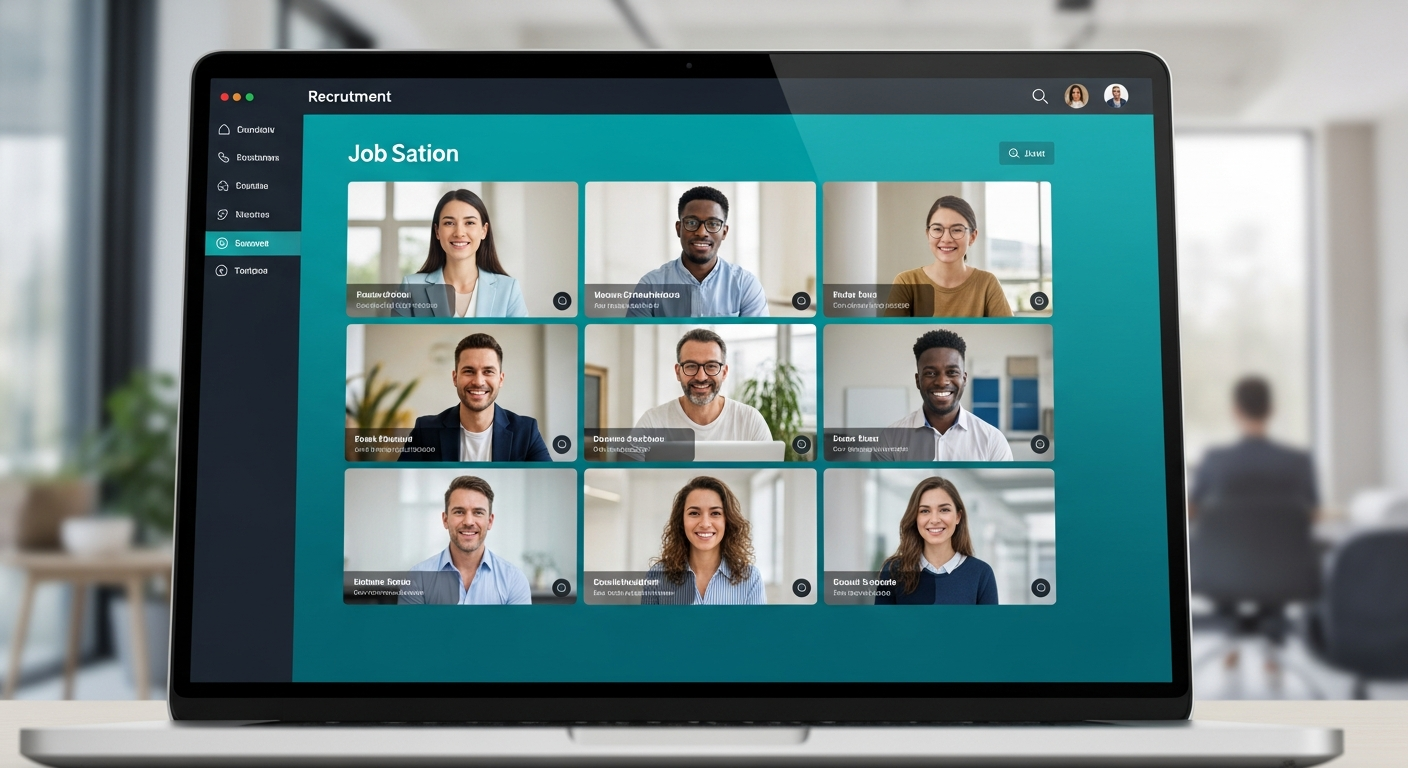


Async video interviews are replacing phone screens at scale. LinkedIn’s 2026 Global Talent Trends report found that over 60% of companies now use some form of one-way video interviewing in their initial screening process — up from 22% just four years ago.
The challenge isn’t the technology. It’s knowing which questions actually reveal candidate fit when there’s no live interaction, no follow-up probing, and no body language exchange. A great async interview question is an entirely different animal from a great live interview question.
These 30 questions — organized by role — are used by hiring teams across 500+ companies. Each is designed to elicit specific, evaluable answers within 60 to 90 seconds, without advantaging extroverts or penalizing candidates from different cultural communication norms.
What Makes a Good One-Way Video Interview Question?
Before the question list, it’s worth understanding the criteria. A strong async interview question has four characteristics:
- Specificity: “Tell me about yourself” is the worst async question ever written. Without a live interviewer to redirect, candidates ramble for 90 seconds about their CV. Instead, ask about a specific situation, decision, or result.
- Behavioral/hypothetical balance: Behavioral questions (“tell me about a time you…”) reveal actual past behavior — the best predictor of future performance. Hypotheticals (“what would you do if…”) reveal thinking frameworks. Use roughly 70/30 in favor of behavioral.
- Short-answer potential: The question should have a complete, satisfying answer within 60 to 90 seconds. If the ideal answer would naturally take 5 minutes, the question is too broad for async format.
- Introvert-neutral design: Live interviews disproportionately reward extroverts and those who “perform” well under social pressure. Good async questions reward clarity of thought and specific examples — which correlate more strongly with job performance than interview charisma.
General and Culture Fit Questions

These questions work across every role and seniority level. They reveal self-awareness, values alignment, and communication style.
1. “Describe a time you had to figure something out completely on your own. What was the situation, and what did you do?”
What to look for: Resourcefulness, intellectual honesty, and the ability to operate without hand-holding. Strong answers include a specific situation (not vague), a clear problem-solving process, and an honest outcome — including if it didn’t work perfectly the first time.
2. “What does ‘doing good work’ mean to you? Give a specific example from your last role.”
What to look for: Quality standards and intrinsic motivation. The example is more revealing than the definition — listen for whether the candidate self-imposed the standard or was responding to external pressure.
3. “Tell us about a project you’re genuinely proud of — what made it meaningful to you personally?”
What to look for: What the candidate finds intrinsically rewarding. This reveals value alignment and what conditions help them do their best work. Bonus: the “genuinely” and “personally” modifiers reduce performative answers.
4. “How do you prefer to receive feedback? Can you share an example of feedback that changed how you work?”
What to look for: Growth mindset and receptiveness to coaching. The second part is the real test — candidates who struggle to name a specific piece of impactful feedback are often defensive about performance issues in practice.
5. “What’s one thing you’d want us to know about you that your resume doesn’t show?”
What to look for: Self-awareness and the ability to articulate non-obvious strengths. This often surfaces the most interesting signal of all five general questions — and gives candidates who interview poorly on paper a chance to show character.
Sales and Business Development Questions
6. “Walk me through a deal you lost. What happened, and what would you do differently?”
What to look for: Accountability, post-mortem thinking, and the absence of blame-shifting. Elite salespeople lose gracefully and learn from losses. Candidates who blame the prospect, pricing, or product reveal something important about how they handle adversity.
7. “Describe your process for researching a prospect before your first outreach. What do you look for, and why?”
What to look for: Preparation habits and the strategic thinking behind their research. Strong candidates connect their research to specific talking points — not just “I check LinkedIn.”
8. “Tell me about a time you had to get creative to reach a hard-to-access decision-maker. What did you try, and what worked?”
What to look for: Persistence, creativity, and comfort with ambiguity. The best SDRs and AEs find a way when the standard path is blocked.
9. “What’s your approach when a prospect says ‘we’re happy with what we have’? Walk me through a specific example.”
What to look for: Objection handling methodology and the ability to reframe without being pushy. The specific example requirement filters out candidates who give textbook answers without having actually done it.
10. “Describe your most successful quarter. What did you do differently during that period compared to average quarters?”
What to look for: Self-awareness about the inputs that drive outcomes. Strong candidates can isolate variables — “I changed my prospecting sequence cadence, which increased reply rates by 30%” — rather than attributing success to effort alone.
Software Engineering and Technical Questions
11. “Tell me about a technical decision you made that you later regretted. What did you decide, and what would you do differently now?”
What to look for: Technical humility, post-mortem thinking, and an evolved perspective. The best engineers can articulate exactly why a past decision was wrong — not just that it was wrong.
12. “How do you approach a codebase you’ve never seen before? Walk me through your first week in a new repo.”
What to look for: Onboarding methodology and the ability to build mental models efficiently. Strong engineers have a systematic approach — reading documentation, running the test suite, finding the entry points — rather than diving randomly into files.
13. “Describe a performance problem you diagnosed and fixed. How did you find the root cause?”
What to look for: Debugging methodology and systematic thinking. The diagnosis process is more revealing than the fix itself — listen for profiling, hypothesis testing, and structured elimination.
14. “Tell me about a time you had to push back on a feature request or technical approach from a non-technical stakeholder. How did you handle it?”
What to look for: Communication across knowledge gaps and the ability to advocate for technical quality without being obstructive. This is critical for senior engineers who need to influence without authority.
15. “What’s your approach to code review — as the reviewer and as the person being reviewed?”
What to look for: Collaboration philosophy and the balance between high standards and psychological safety. Strong candidates see code review as a learning conversation, not a gatekeeping exercise.
Marketing and Content Questions
16. “Tell me about a campaign or piece of content you created that significantly underperformed your expectations. What did you learn?”
What to look for: Analytical thinking and the willingness to own failure. Strong marketers can diagnose why something didn’t work — audience mismatch, wrong channel, weak hook, poor timing — rather than attributing underperformance to chance.
17. “Walk me through how you’d approach building a content strategy for a product you know nothing about yet. Where would you start?”
What to look for: Research methodology and the ability to build from first principles. Strong candidates start with audience research, not content formats.
18. “Describe the most complex multi-channel campaign you’ve managed. How did you coordinate across channels, and what would you do differently?”
What to look for: Operational sophistication and cross-functional coordination ability. Look for specific tools, processes, and lessons — not general descriptions of “working across teams.”
19. “Tell me about a time you had to defend a creative decision with data. What was the decision, and how did you make the case?”
What to look for: The ability to bridge creative instinct and analytical rigor. This is a critical skill in marketing — knowing when to trust the data and when to trust your gut, and being able to articulate which is driving a decision.
20. “What’s a marketing channel or tactic you’re most skeptical of right now, and why?”
What to look for: Independent thinking and the ability to hold nuanced views on conventional wisdom. Strong marketers question the herd — and can back their skepticism with evidence or reasoning.
Customer Success and Support Questions
21. “Tell me about the most difficult customer situation you’ve handled. What made it difficult, and how did you resolve it?”
What to look for: Emotional regulation under pressure and the ability to de-escalate while maintaining customer trust. The resolution matters, but the emotional handling during the situation is equally important.
22. “Describe a time when you spotted a customer at risk of churning before they said anything. How did you identify it, and what did you do?”
What to look for: Proactive account management and pattern recognition. Strong CS professionals read early warning signals — engagement drops, missed check-ins, changing stakeholders — and act before the conversation gets difficult.
23. “How do you manage your time when you have 20 customer accounts in various stages of onboarding simultaneously? Walk me through your system.”
What to look for: Prioritization frameworks and operational discipline. The “system” is key — strong candidates can describe their specific approach, not just that they “stay organized.”
24. “Tell me about a time you turned a frustrated customer into a genuine advocate. What was the turning point?”
What to look for: The ability to find leverage moments in difficult relationships. Strong CS professionals understand that service recovery done well can create stronger loyalty than if the problem never occurred.
25. “What does great onboarding look like to you? Describe the ideal first 30 days for a new customer.”
What to look for: A customer-centric onboarding philosophy and the ability to articulate specific milestones, communications, and success criteria — not just “make them feel welcome.”
Leadership and Management Questions
26. “Tell me about someone you managed who wasn’t performing well. How did you approach it, and what was the outcome?”
What to look for: Performance management philosophy and the balance between accountability and support. Avoid candidates who either immediately managed out or indefinitely accommodated underperformance.
27. “Describe a time you had to make a significant decision with incomplete information and a tight deadline. How did you decide?”
What to look for: Decision-making frameworks under uncertainty. Strong leaders can articulate what information they had, what they’d ideally have had, what framework they applied, and how they communicated the decision.
28. “Tell me about a time you inherited a team that wasn’t high-performing. What was your approach in the first 90 days?”
What to look for: Leadership philosophy and the specific tactics used to assess, motivate, and develop a team. This reveals whether the candidate leads through trust-building or compliance.
29. “How do you identify and develop high-potential employees on your team? Give a specific example.”
What to look for: A concrete talent development philosophy and the specific mechanisms used — not just “I give them more responsibility.” Great leaders can name the stretch assignments, feedback cadences, and sponsorship they provided.
30. “Tell me about a time you had to change your mind publicly on an important decision. How did you handle it with your team?”
What to look for: Intellectual humility and the ability to model psychological safety. Leaders who can’t update their views publicly create cultures where admitting mistakes is career-limiting.
How to Set Time Limits for Video Interview Questions
Time limits are one of the most important and most poorly calibrated settings in async video interviews. Here are evidence-based guidelines:
- 60 seconds: Culture fit, motivation, and simple preference questions. “What does good work mean to you?” needs 60 seconds, not 90.
- 90 seconds: Behavioral STAR questions (Situation, Task, Action, Result). Most behavioral answers that need setup + context + outcome fit comfortably in 90 seconds.
- 2 minutes: Technical explanation questions where the candidate needs to walk through a system, decision process, or complex scenario.
Never exceed 2 minutes per question. Research on async video completion rates shows a 40% drop when candidates are given more than 2 minutes per question — not because the content is worse, but because candidates over-think, re-record, and eventually abandon. Tighter constraints produce more natural, authentic answers.
Keep the total interview to 5 questions or fewer. At 5 questions with 90-second limits, the total recording time is under 8 minutes — a reasonable request that maintains high completion rates. Every additional question reduces completions by roughly 8-12%.
How to Evaluate One-Way Video Interview Answers Without Bias

Structured evaluation is the most important bias-reduction tool available to hiring teams. Here’s a framework that works:
Rubric: 0-3 Scale Per Criterion
- 0: Not addressed / irrelevant answer
- 1: Addressed but vague, no specific example
- 2: Specific example present, partial STAR structure
- 3: Specific, concrete example with clear outcome and self-awareness
Core Evaluation Criteria
- Communication clarity: Can the candidate explain complex things simply? Do they structure their answer logically?
- Specificity: Do they name real situations, real numbers, real outcomes — or give general descriptions?
- Self-awareness: Do they reflect on what they learned, what they’d do differently, what their role was in success or failure?
- Role-relevant competency: Does the answer demonstrate the specific skill the question is designed to assess?
Blind Review Mode
Where possible, rate on the transcript first, then watch the video. This reduces halo effects from appearance, accent, and non-verbal style — none of which correlate with job performance. RecRam’s recruitment platform includes AI-generated transcripts and an automated first-pass scoring layer to make this workflow practical at scale.
How to Send One-Way Video Interview Invitations
The invitation sets the tone. Many candidates have never done an async video interview before — your invitation needs to demystify the format and reduce anxiety.
Subject: Next step: a short video interview (no scheduling required)
Hi [First Name],
Thank you for applying for [Role] at [Company]. We’d like to move forward with a brief video interview — the async kind, which means you record your answers on your own schedule, no live call required.
Here’s what to expect:
- 5 questions, each with a 90-second time limit
- You’ll see the question before you start recording
- You can take one practice run before your recorded answers
- No account creation, no app download — just open the link in your browser
- Deadline: [DATE]
Start your interview here: [RecRam Link]
If you have any questions, reply to this email. Good luck!
[Your Name]
[Company] Recruiting Team
Key elements of this template: it explains the format upfront (no surprises), sets clear expectations on length and deadline, and explicitly addresses the most common candidate anxiety (no app, no account).
For teams managing high-volume hiring, RecRam’s recruitment solution automates invitation sending, tracks completion status, and surfaces AI-scored results — so hiring managers only review the top 20% of responses.
Frequently Asked Questions
Are one-way video interviews legal and GDPR compliant?
Yes, with proper consent disclosure. Candidates must be informed that their video will be recorded and how it will be used. GDPR requires explicit consent and a clear data retention policy. RecRam is GDPR compliant, stores data in EU-region servers, and includes consent capture in the candidate flow. Always include your data processing disclosure in the interview invitation email.
Can candidates re-record their answers?
This is a platform setting that varies by tool. RecRam allows you to configure re-record allowances per question — typically one re-record is permitted for culture questions, zero for time-pressured situational questions. Allowing unlimited re-records increases the time candidates spend but can produce more polished (less authentic) answers. One re-record per question is the recommended balance.
How many questions should a one-way video interview have?
Three to five questions is the sweet spot. Three is ideal for early-stage screening (role basics + one culture + one behavioral). Five is the maximum for a comprehensive pre-screen. More than five significantly reduces completion rates — candidates abandon long async interviews at rates that eliminate your best candidates, who have the most options.
Do candidates get to see the questions before recording?
Best practice is to show the question with a 30-60 second preparation window before recording begins. This reduces the “deer in headlights” effect and produces more structured answers — without giving candidates time to over-polish. The preparation window is configurable in RecRam.
How do I score one-way video interview answers fairly?
Use a structured rubric (0-3 scale per criterion), read transcripts before watching video to reduce appearance bias, and have at least two evaluators score independently before comparing. RecRam’s AI-first-pass scoring can flag the top and bottom performers automatically, concentrating human review time where it adds the most value.
Screen more candidates in less time
RecRam’s recruitment platform lets you send async video interviews, get AI-scored results, and shortlist the top 20% — without scheduling a single call.
Ready to try it?
Stop reading. Start listening.
RecRam turns feedback into video conversations your team actually watches. Free forever, no credit card required.
Start Free — No Credit Card
Written by
RecRam
Part of the Recram team — building the future of video‑first feedback.


